





When embarking on a new product venture, one pivotal question often arises early in the process: Should we build or buy our MVP (Minimum Viable Product)? While numerous articles discuss how to approach this decision, few address it through the lens of MVP-focused strategy—starting small to progressively achieve your product vision.
MVP Build or Buy: Learning
The primary goal of an MVP is learning. Does an out-of-the-box solution exist that can facilitate this initial learning phase? If not, is it more feasible to build a custom solution or to modify an existing service? Sometimes, a hybrid approach is best, using existing services as a foundation for your MVP.
MVP Build or Buy: Time to Market
Speed is crucial. The faster you can place your MVP in users’ hands, the quicker you can gather feedback. Assess which option—building or buying—will allow you to enter the market more rapidly, even if the initial product is rudimentary.
MVP Build or Buy: Effort
Consider the effort involved. A high-effort approach might delay learning and feedback. Evaluate whether building or buying offers a path of lesser resistance and quicker deployment of your MVP.
MVP Build or Buy: Cost
Cost considerations are closely tied to effort. Analyze the financial implications of each option. How does the cost of purchasing pre-built solutions compare to the expense of developing in-house?
MVP Build or Buy: What if Success
Imagine the best-case scenario: your MVP is a resounding success. Which option allows you to scale swiftly and add features in line with your long-term product vision?
MVP Build or Buy: What if Failure
Conversely, consider the implications of the MVP not meeting expectations. Which option—build or buy—makes it easier to pivot or terminate the project with minimal losses?
MVP Build or Buy: Decision Matrix
To systematically address these factors, I use a decision matrix that scores each criterion from 1 to 5—1 being least favorable, and 5 being most favorable. Stakeholders and researchers should be involved in this scoring process to ensure a well-rounded decision.
MVP Build or Buy: Decision Matrix Score Calculation
To systematically evaluate each option—build, buy or another alternative—we calculate each option score based on the following criterion on a scale from 1 to 5:
- Learning: 1 (provides little learning about the product) to 5 (provides crucial learning about the product).
- Time to Market: 1 (slows market entry) to 5 (accelerates market entry significantly).
- Effort: 1 (requires significant effort) to 5 (requires minimal effort to launch).
- Cost: 1 (highly expensive) to 5 (highly economical).
- What if Success: 1 (difficult to scale and meet high demand) to 5 (easy to scale and handle success).
- What if Failure: 1 (complicated and costly to discontinue) to 5 (easy and inexpensive to wind down).
Scores for each criterion are summed to determine the most viable option. The choice with the highest total score is considered the best, as it aligns closely with our strategic and operational goals.
MVP Build or Buy: Excel Tool for Decision Making
To assist stakeholders in applying this matrix, I have created and used a MVP Build or Buy Shared Excel tool (open it, then make a copy in order to use it). This shared excel will feature a template where users can input scores for each criterion across different options. The Excel sheet will automatically calculate the total scores, helping to visualize and compare the potential outcomes of the build or buy decision. This hands-on approach ensures that all involved parties can actively participate in the evaluation process, making the decision-making more collaborative and data-driven.
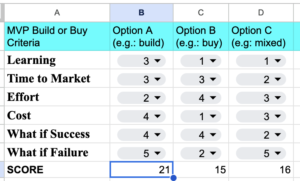
sample MVP build or buy result
In Summary
The decision to build or buy an MVP can be highly effective when stakeholders and researchers—who have thoroughly examined both purchasing and building options—are actively involved in the decision-making process. This approach is particularly beneficial for organizations that are committed to leveraging MVP strategies.
If your organization’s goals extend well beyond the MVP stage, consider adopting a more comprehensive process (here are a few recommended articles: here, here and here) . You should invest more time in broader strategic planning. In such cases, the insights from this article might be less applicable. Additionally, a Lean Inception workshop, designed to align team members on the MVP and broader product goals, may not be as beneficial for teams that want a detailed and final plan.
