Scrum is an agile framework to solve complex projects. Scrum was initially built to software development projects, but it has been applied in any scope of complex projects and innovative work.
Scrum is especially adequate to projects with requirements that change fast or are highly emergent. The software development with Scrum progresses through a series of iterations called Sprints that last typically from one to four weeks.
Scrum ceremonies
The Scrum model suggests that each Sprint starts with a brief planning meeting and end up with a review meeting on the work done in the Sprint. These are the principles of the Scrum project management: short and rhythmic cycles with alignment meetings, following up on the work evolution and the team improvement.
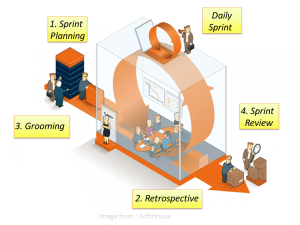
Aside the (1) planning and (4) review meetings, the Scrum suggests two more meetings that happen at each Sprint, which are: (2) retrospective, the meeting that brings up the kaizen moment, in which the team seeks for continuous improvement regarding the process, the delivery and the interaction amongst people; (3) grooming, the meeting in which the product backlog is revisited looking for the understanding of the next requirements, candidates for the next Sprint.
The Sprint
The Sprint promotes a cadence, typically from one to four weeks, depending on the team’s preference. However, the team gathers up on a daily basis to check the progress of the tasks. This happens on the Daily Sprint meeting, in which all team members stand up (so the meeting doesn’t take too long) and answer to three questions that help the team to self-organize, seeking for a daily alignment regarding the work of the Sprint. The three questions are: what did I do yesterday, what am I going to do today and what is preventing the progress of my work.
In the agile Scrum world, we avoid complete and detailed descriptions of how the Sprint work should be carried out. The work details are left for the development team to decide. That’s because the team will know the best way to solve the given problem.
That’s why the planning meeting of the Sprint is described in terms of goals and desired outcome. The desired outcome is a commitment with a set of features to be developed, or things to be accomplished in the next Sprint, thus seeking for the balance among autonomy, flexibility and team commitment. Such commitment is revisited by the end of the Sprint, in the review meeting.
The Scrum team
The Scrum promotes a multi-functional and self-organized team. The team efficiency depends on the capacity of the members of working together and making the best use of individual skills. The Scrum team is self-organized because there shouldn’t be a team leader who decides who is going to do each task and how. Tasks and problems are brought up by everybody and these are decided by the team as a whole.
Scrum teams are supported by two specific roles. The first one is a Scrum Master, someone who has expertise with the framework who can help the team to use the Scrum process to reach the high level goals. The best Scrum Masters are those people who get more satisfied facilitating the success of others than their own. The Scrum Master must feel comfortable and secure with the framework to the point of giving full control regarding the product to the Product Owner (PO) and full control regarding the product development to the team.
The second specific role is the Product Owner (PO). The PO represents the business, the clients or users, and guides the team to build the right product. The PO must lead the effort to development through elucidations and prioritizations on the work.
Typically, the PO works with the Product Backlog, the master list of the features from the product to be built. It is its function to prioritize the backlog based on the business value and on the alignment between the stakeholders, both intern and extern regarding the Scrum team. As such, the PO must be available to the team to answer the questions and guide the team at each moment or inquiry.
This combination of authority and availability to the development team makes the PO a key piece of the framework. The Scrum values the team’s autonomy and self-organization; therefore, the PO must respect the direction and the ability of the team on creating its own plan of action.
Teamwork, Cadenced Alignment and Clarity
The Scrum team – the Scrum Master, the PO and all team members (with their various roles) – participates actively in all meetings with a high level of autonomy, transparency and commitment. In the Sprint planning, the team decides the Sprint backlog, which is followed up daily (Daily Sprint) and re-evaluated in the Sprint review. Through the search of continuous improvement (emphasized on retrospectives), typically the Scrum team performs on high levels of efficiency. A lot of that is reached with teamwork, the cadenced alignment via Sprints and the clarity of each role and meeting.