I was thinking about MVP – Minimum Viable Product, and remembered of something I read about Buddhism, that related happiness to the absence of expectation. This philosophy and mindset also apply to innovation and entrepreneurship. Think about the creation of a product and the expectation over it.
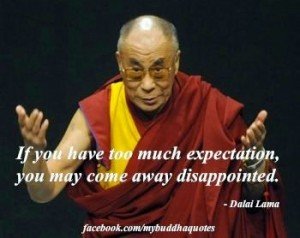
Think about this philosophy – expecting too much might get you disappointed. It also also applies for the minimum viable product.
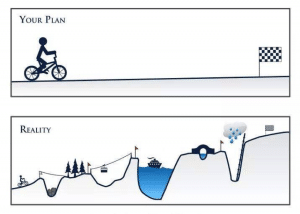
When, traditionally, we used to think and plan a product, we put up a lot of expectation on it. Ergo, we rarely reached high levels of satisfaction. Usually, reality is not as simple as the original plan.
Satisfaction with the product
The complete product takes time to be created. All that time generates great expectations. So you have dissatisfaction, even achieving a good result.
In contrast, when we plan and create an MVP in a short time, we are dealing with low expectations. For that reason, satisfaction regarding the MVP tends to be bigger, no matter if the result falls short of what we were expecting from the complete product.
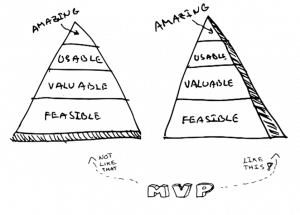
For example, consider the following two images:
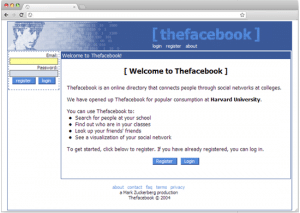

These were the original Facebook pages, a great example of a MVP. I wonder how much satisfaction Mark Zuckerberg got from it.
This shows when we put the information into a mathematical formula:
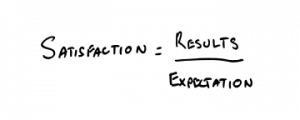
Consider the MVP’s expectation with a value X, while the complete product expectation has a value 10X. To reach the same satisfaction level, the result of the product would have to be 10Y when compared to the result Y of a MVP.
However, what usually happens is that the real results are low, no matter if it’s a MVP or a fully elaborated product, with many features. Ergo, the satisfaction with MVP tends to be bigger than with products created traditionally.
But what is MVP expectation?
Now let’s change the focus. I don’t want to think about the expectation only regarding the building time. Let’s think of what is MVP expectation.
It may not seem much, but it’s a brutal difference: the expectation over a complete product versus the expectation over a MVP.
For the complete product, we expect revenue, sales, that all features work, etc.
For the MVP, it’s ok if you reach those positive results (revenue, sales, etc.) with the product. However, the expectation over a MVP is learning. The MVP will generate metrics to help our decision-making.
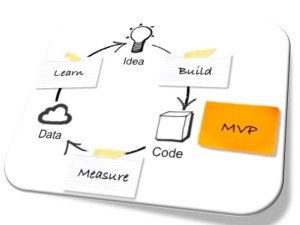
The difference is subtle, but highly impacting. With the MVP, you’re not attached to results, but to learn. That reminds me of another Buddhist sentence: “the root of suffering is attachment”.
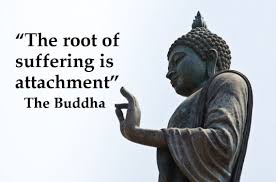
Don’t get attached to results. Instead, be happy with the learning achieved by the MVP. The learning will bring you wisdom. You´ll be able to make better decisions; for example, you might say: (1) yes, let’s go on that direction because the result – the numbers – indicate that it’s worth; or (2) let’s change direction, for the result – the numbers – indicate that we should try something different.
An example of entrepreneurship
Consider this example: Luiza, an entrepreneurship, has an idea for a product to sell children dresses online. Now, consider these two scenarios.
In the first scenario, assume that the idea is wonderful and as soon as her website is working, Luiza is going to sell more than two hundred dresses per week, considered an excellent result.
In the second scenario, presume that the idea is not pay off. And as soon as her website is working, Luiza will sell less than ten dresses per week, a result considered awful.
If Luiza is looking for results, she will be happy with the first scenario and very sad with the second one. But if Luiza works with the MVP philosophy and, instead of seeking results, seek for learning, she will be pleased regardless the scenario, because she will have important data to decide whether to take the idea further or not.
Working with MVP, Luiza will not build the whole site, only the minimum viable to learn about the interest of her potential customers in buying dresses online. In her search for learning, in a few days (estimated time to create the MVP plus the data collection time on the interest on the product), Luiza is able to validate (or invalidate) her idea.

Luiza will create the MVP to look for learning. If the idea proves itself to be amazing, she will be very satisfied, will evolve her product (beyond the MVP) with steadier steps, and will be more certain of getting a good return over investment. But, on the other hand, if the idea proves itself not lucrative, her satisfaction will be huge, for she managed to invalidate the idea without spending a lot of time, money and effort. And she’ll be able to decide the next step: what to do differently in order to continue undertaking in this area of interest.
For business and for life
“Act without expectation” – Lao Tzu
Act without expectation (at least, with a few). I recommend! Whether in your life or in your next enterprise. Go on, elaborate your MVP, your minimum viable product, and validate your hypotheses before creating too many expectations or getting attached to something.
[content_block id=2985 slug=baixe-o-tothepoint]
[content_block id=4581 slug=read-lean-inception]