





The other day I went to a Japanese restaurant for a snack.
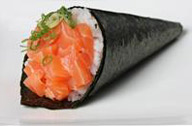 |
| Small order – Temaki |
I was very hungry and wanted something simple and fast. I ordered one temaki. Unfortunately, it took me more than 30 minutes to get my temaki. Needless to day, I left the restaurant very frustrated and unhappy with the service.
After a few months, I went back to the restaurant and took a look at their kanban system. I noticed that all orders follow a single queue.
Let me explain the restaurant simple workflow: The waiter collects the order, and then he places it on the suchiman queue. Once the suchiman finishes working on the current order, he picks up the next one from the queue. The drawing below replicates the scenario that happened when I ordered a temaki.
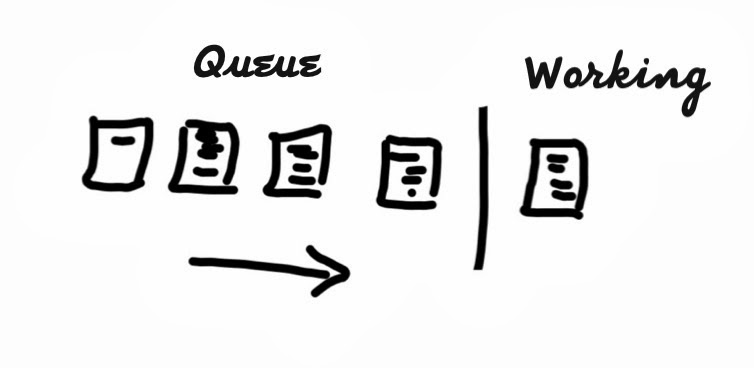 |
| Single Queue |
My temaki order is the last one on the queue. It has only a line, representing a small snack. The orders in front of it have more lines, representing larger orders.
Consider that each large order takes approximately 10 minutes, and that a small order (my temaki) takes one minute.
Following the single queue workflow my order did take more than 30 minutes.
Let’s now use the same workflow (with the same style of visual management and order control), but with a small change: two queues instead of a single one. Temaki and simple appetiser goes through the small order queue; everything else goes through the large order queue.
 |
| Dual Queue |
Consider the change from a single order queue to a dual queue, the model represented above. Also, consider that the suchiman gives priority to small order instead of starting on a large one.
By following this model, my temaki wait time would have reduced substantially. It would be at most 11 minutes, instead of at most 41 minutes.
This illustrates the dual queue concept. I am sure you can relate to it and can name quite a few places you have seen it (or missed it) before.
A few flow concepts illustrated on this example;
- class of service – the types of work items on this system; large order and small order
- lead time – the time it takes for one work item, from the time an order is placed until it is delivered
- WIP – the number of work itens being worked on at the same time at the same time. In this example, WIP equals 1 (there is only one sushiman who works on one order at a time)
- pull system – once the sushiman finished working on an order, he pulls the next one


