



Lean Inception for AI agents is emerging as a critical practice for teams navigating the fast-changing world of autonomous software. As AI agents move from novelty to necessity — acting with autonomy to complete tasks, learn from interactions, and even generate value — traditional product planning no longer works.
You can’t predict everything an agent will do in production. But you can set your team up for success by aligning on the right MVP and strategy. That’s where Lean Inception becomes your advantage: a proven method to align, learn fast, and build the right thing — now with agents in the mix.
1. Why Build-Measure-Learn Is Non-Negotiable for AI Agents
In an agentic world, the Lean Startup loop of build-measure-learn is essential. Your AI agent might be trained on the right data and prompted well — but once it’s live, behavior varies by context, inputs, and updates.
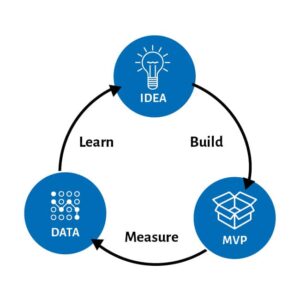
That’s why MVPs matter. A Minimum Viable Product lets you validate whether your assumptions hold up in reality. Lean Inception helps your team align around:
-
What you’re trying to learn.
-
How you’ll measure it.
-
The minimum slice of product that gets you there.
The faster you learn, the faster your AI product evolves — and survives.
2. Think Big, Start Small: Thin Slices Lead to Smart Products
It’s tempting to launch an agent with a full set of features — but that’s risky. AI agents introduce complexity, uncertainty, and ongoing evolution.
Lean Inception focuses your efforts on a “thin slice” — a small yet valuable version of your product vision. This slice is:
-
Valuable for users (and agents).
-
Usable in the real world.
-
Feasible for the team to build quickly.
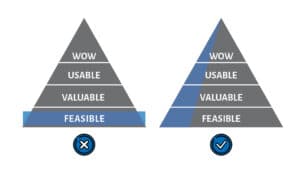
You can always expand later. But starting small gives you speed, clarity, and data — exactly what you need when building in the unknown.
3. Including Agents in Personas and Journeys
Lean Inception traditionally helps teams understand users via personas and their user journeys. With AI agents, some of those “users” are no longer human.
Now, your Lean Inception should include:
-
Agents as personas – think of a sales agent or scheduling agent as an actor with goals and limits.
-
Agent steps in user journeys – include moments where agents perform tasks, initiate actions, or collaborate with humans.
-
Hybrid interaction flows – understand how people and agents interact across touchpoints.
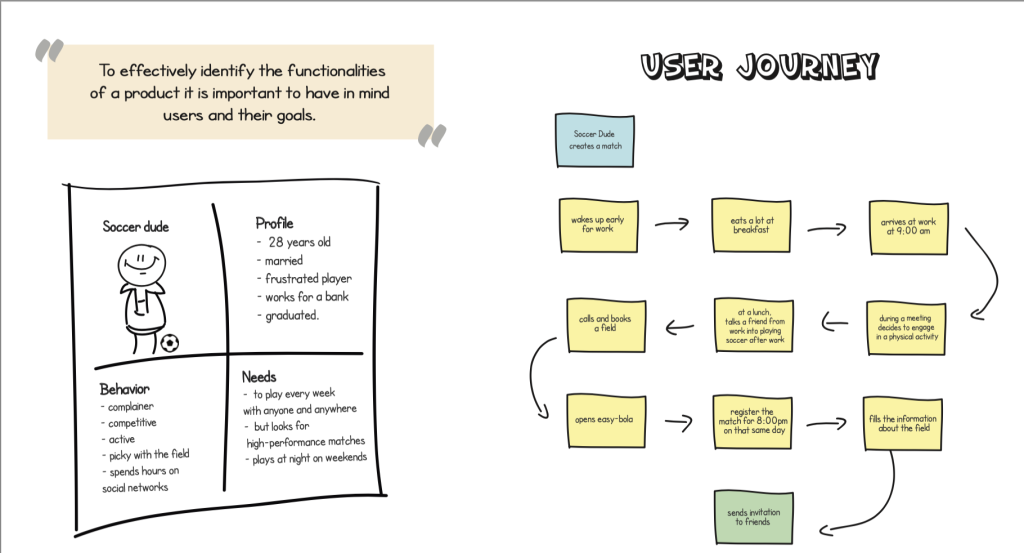
Designing for humans and agents ensures a more robust flow.
4. Add AX to the UX-Business-Tech Review
One of the key moments in Lean Inception is reviewing features through the lenses of:
-
Business value.
-
Technical feasibility.
-
User experience.
Now, consider adding a fourth: AX – Agent Experience.
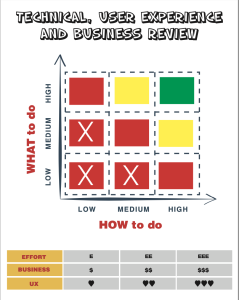
Ask:
-
Is the agent’s environment stable and predictable?
-
Are prompts and context engineered clearly?
-
Will the agent be able to operate reliably in real-world usage?
Poor AX leads to agent failure — just like bad UX turns users away. In the AI era, they’re both crucial.
5. Human-Agent Co-Creation: How I Use Agents During Lean Inception
AI agents aren’t just inside the product — they’re now part of the product design process.
Here’s how I use them:
-
ChatMVP.ai helps during MVP Canvas discussions. It reviews hypotheses, suggests improvements, and prompts questions to refine the product proposal.
-
FeatureCraft — Lean Inception Feature Refiner is a tool I created to help me during Lean Inception workshops. As a facilitator, one of the biggest challenges I face is turning vague feature ideas into clear, actionable items. Writing strong features is fundamental — they’re the LEGO bricks of your product. If the features are ambiguous or misaligned, you’ll struggle to define the MVP or plan product increments effectively. FeatureCraft helps refine those initial ideas, making them concrete, specific, and aligned with business goals, user needs, and technical feasibility.
These agents act like co-facilitators. They don’t replace the team — they enhance it. They offer clarity, challenge assumptions, and keep momentum high.
Why Lean Inception Is Your Superpower in the Agentic Era
AI agents are changing how we live, work, and build. But with that transformation comes complexity and uncertainty.
Lean Inception equips teams with the clarity and structure they need to reduce risk, validate faster, and co-create products that merge human insight with machine autonomy.
If you’re building with or for AI agents, you need a process that’s as agile as the technology you’re using. Lean Inception helps you define a shared vision, align stakeholders, and identify the thin slice to build, test, and learn — fast.
This is not just a methodology for agile teams. It’s a mindset for the agentic era.