Below is a FunRetro agenda for a series of team-building activities designed to help a group align on goals and expectations.
This agenda has been effectively applied in teams experiencing discord. Misaligned expectations were often the culprit, and the following sequence of activities has proven helpful. The process begins with establishing a common team goal (which is typically simpler to achieve) and proceeds to address the critical matter of expectation alignment.
Set the Context
The context I establish for this agenda is as follows:
“Let’s reflect on our role as a team, our shared goal, and our individual expectations of one another in pursuit of this common objective.”
Prime Directive
I have employed the team-building prime directive:
´Cooperation is the act of working with others and acting together to accomplish a job. Team is a partnership of unique people who bring out the very best in each other, and who know that even though they are wonderful as individuals, they are even better together. Coming together is a beginning; keeping together is progress; working together is success.’ – FunRetrospective Team Building Prime Directive
This agenda has been utilized in two distinct scenarios:
- At the onset of team formation (this context proved more straightforward). The prime directive was ideally suited for this phase.
- When a team sought assistance as they struggled with cohesion. In such cases, I could either organize a retrospective (with retrospectives activities) or apply the agenda in this post. I opted for the latter upon discerning that the root issue was ineffective team formation, hence the choice for team building activities and prime directive.
Define the Team’s Common Goal
To establish the team’s common goal, the following steps were taken to guide the team:
- Reflect on the following team’s definition: “A team is a group of people focused on a common goal, in which each individual adjusts their actions, habits, and work preferences in order to achieve the group’s collective objective.”
- Write down your personal interpretation of what our shared goal is, keeping the team definition in mind.
- Participate in a group dialogue to align and agree on our common goal.
The outcome of this activity was a clearly articulated common goal.
Expectation Matrix
The Expectations Matrix is a team-building activity that outlines team members’ expectations to clarify roles and prevent conflicts arising from unrecognized expectations.
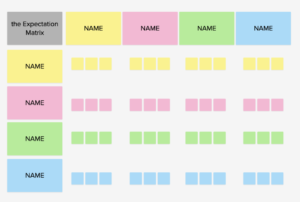
Step by Step:
- Pick a color for your post-it notes. Write your name at the top of a column and the beginning of a row on the matrix board.
- Itemize your anticipated contributions from each team member towards our unified goal (established previously).
- Detail your tailored actions, habits, and work preferences that support the team’s objective.
- Collectively examine and debate the matrix in its entirety to confirm expectations are in harmony. Tip: Proceed column by column, scrutinizing all remarks directed at an individual before moving to the next.
During step 4, I prompted the team to concentrate on these aspects:
- Cross-check what others anticipate from you against your self-assessment.
- Identify the collective blind spot (an essential omission that no one has addressed).
- Detect repeated expectations among members which might cause confusion, signify redundant efforts, or highlight further alignment necessity.
This is a variation of the Role Expectation matrix from FunRetrospectives.com
Check-out – One Word Before Leaving
We concluded with the “one word before leaving” activity:
- Sum up your sentiments in a single word.
- Append your chosen word to the collective canvas.
- Optionally elaborate on your word as we draw this session to a close.
Here is a link to a Mural board template I have created and used for thus agenda. Enjoy!