In 2013, for two months I was involved on a killer project. An amazing team came together in one day to work on a rescue project. The team delivered timely and exceeding expectations. It was composed by 6 developers, one tester, one PO, one architect, and one facilitator (overlooking analysis, communication, project, and process). Here are my notes about this short and successful project.
No process upfront
The project started with no process. Really, no predefined process! On day one, the team decided to have a recurring meeting. Soon it became more like a daily showcase. Later on, the team would do a quick stand up prior to the daily showcase.
On week two the team decided to do a retrospective. Planning or re-planning meetings happened on a weekly basis after the second week.
Tiny stories
Our Stories (or tasks) were small enough to showcase a few of those every day. They were not INVEST by no means. Some were dependent; many were more technical than pure business stories. But all come along together and made sense. And this happened daily! None of these tiny stories/tasks took more than 3 days. One day was the typical time it took.
Daily showcases
Although this was not planned, it started happening from day 2 to the last day of the project. A showcase was done every day in the afternoon.
Everyone would watch the latest working code demo; being it a complete business feature, or a piece of working code towards that direction.
Two stand ups
The team did stand up (a quick sync up) twice a day. In the morning at 10 am, and at the afternoon, right before the daily showcase. It started with showcase, then stand up and showcase, then morning stand up, afternoon quick sync up, followed by a showcase.
Feature wall
The team used a feature wall. On a whiteboard, the main features were stated as columns. Related tasks were listed under each feature. Towards the top was the leading ones (priority or dependent upon). Cards would not move on the wall. Dots were used to identify what was being worked on and what was done.
Conversations over everything else
The daily showcase was a perfect venue for all conversations related to the product. This simplified the need for detailing requirements, and for going further in any direction which was not desired.
The team did not have a rigid predefined process, nor a detailed story backlog. Conversation was the norm. The daily showcase and fast development cycle created a perfect communication channel, avoiding misunderstandings or pre-emptive communication (anything prior to the real work being demosntrated).
Continuous Delivery
The engineers decided to have a CI server working on day 1. Daily showcase was done on a production-like environment. Later, this production-like environment became the production environment. Early on the project lifecycle, the team was doing Continuous Delivery, the software delivery practice that foster faster and frequent deliverable.
Testing
Although everyone on the team comes from a culture of highly automated testing and TDD, the project started without it. Remember, there was no predefined process. Interesting enough, these practices were being added as the project evolved. The pain brought these practices into the picture. There was no debate like: should I test this or not. Once there was pain, tests were added. By pain, I mean two or more people working on the same code (therefore being unconformable with changes), or a bug (write the test, then fix it!).
MVP
Many, many times the team would decide to have the simplest solution before moving towards something more elaborated. And this was the case for technology and business solutions. The product did build up to have an an awesome great list of complete features. It was very interesting to watch how the team MVPed towards it.
Amazing people
Any and each of the things listed here worked for this group of amazing people. To be very honest, I don’t recommend repeating any practice alone. My suggestion is to work with awesome people, open up an effective communication channel, start simple and continuously improve it.
Please find below a few photos for this killer project.

Continuous Integration from day1
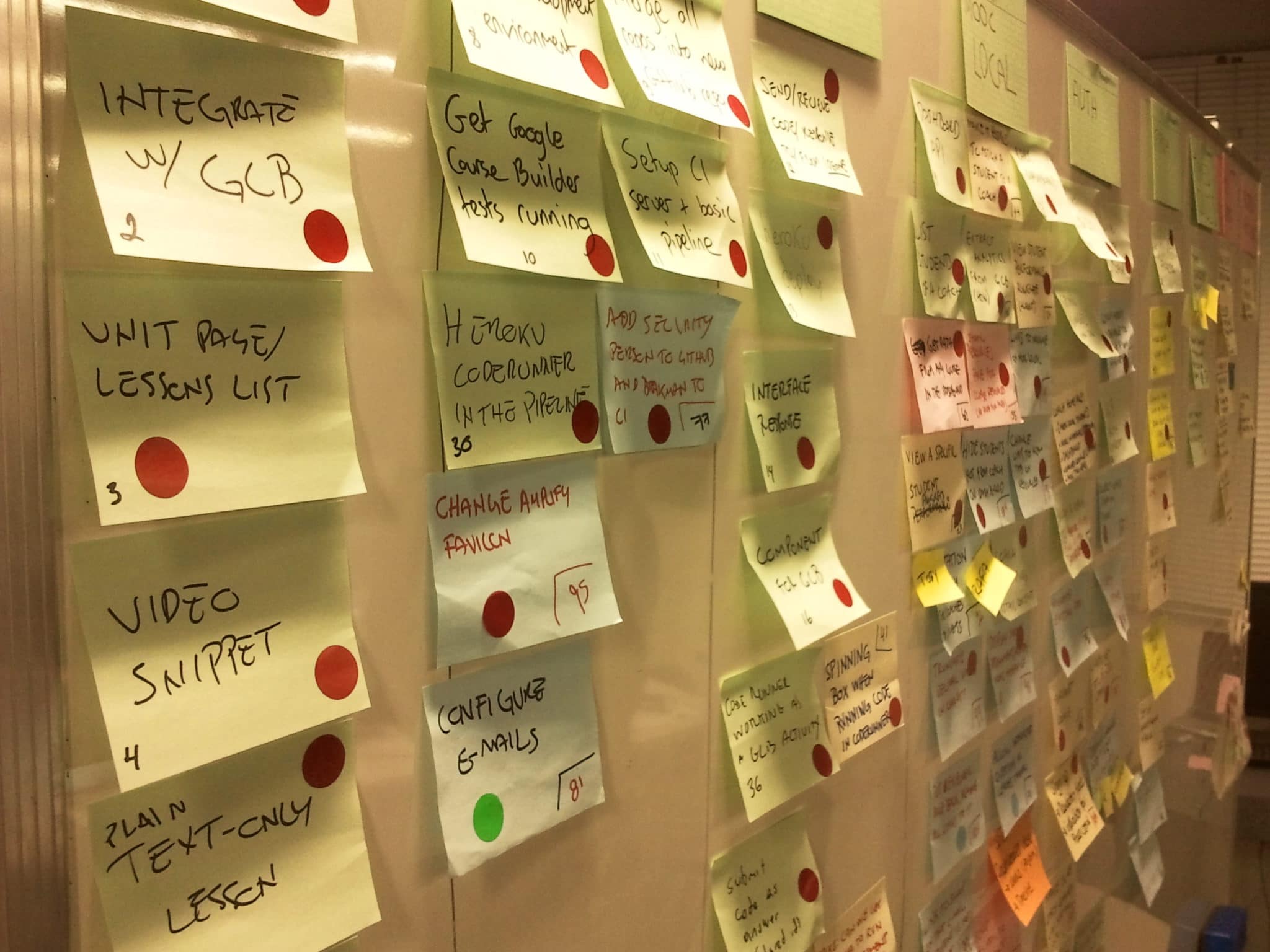
Feature wall

project retrospective