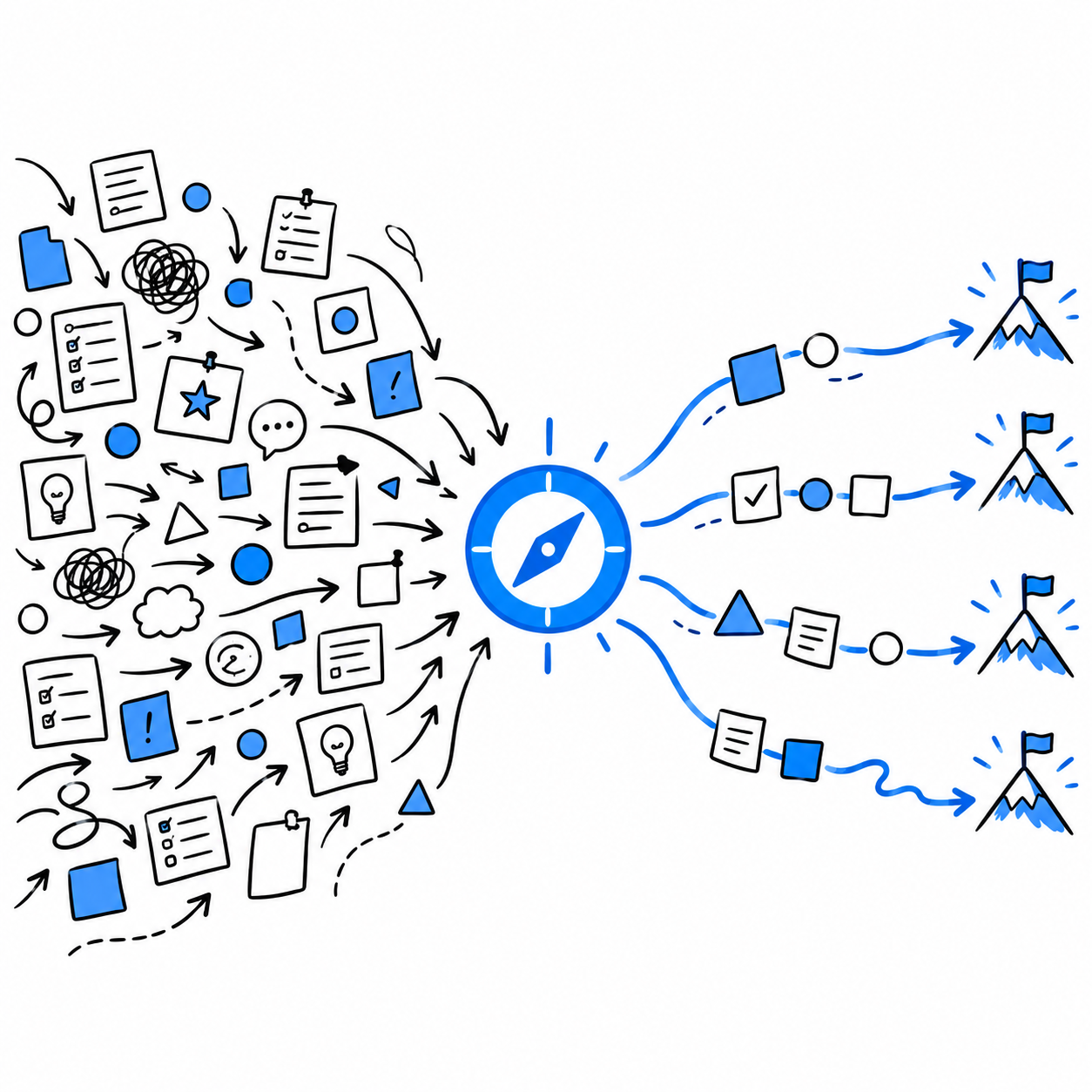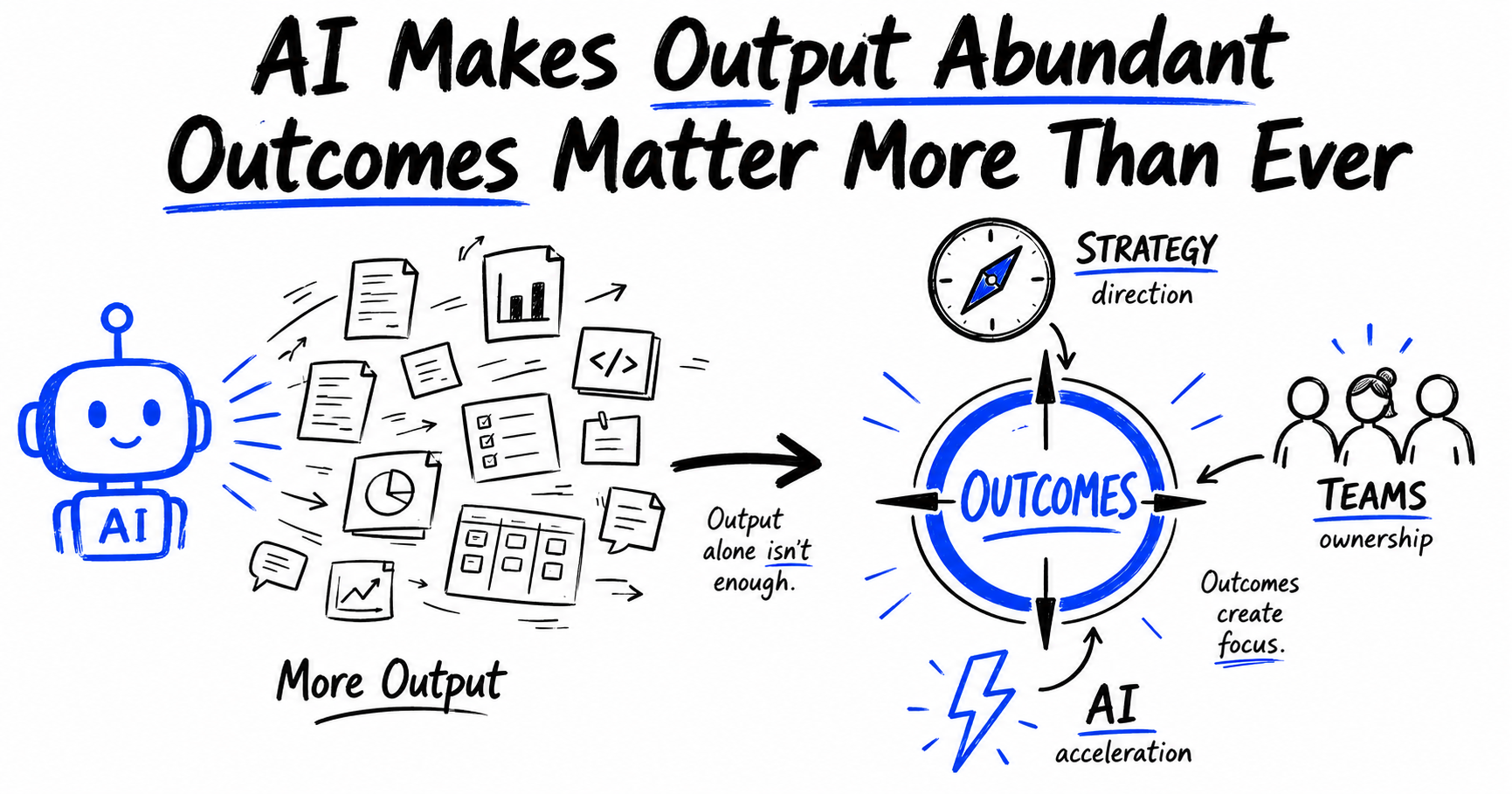




Strategy to outcomes is one of the biggest challenges modern organizations face.
Many organizations invest significant effort in defining strategy.
Leadership teams gather to define priorities, establish goals, and communicate direction across the organization. In many cases, these priorities are expressed through Strategic OKRs or other strategic planning frameworks.
At the same time, many companies are reorganizing how their teams work. Concepts like product teams, platform teams, and stream-aligned teams have become increasingly common.
And in parallel, teams are adopting modern product practices such as continuous discovery, experimentation, and continuous delivery.
Tools evolve. Technologies improve. Teams gain new capabilities that allow them to build, test, and release solutions faster than ever before.
Yet despite all these improvements, the results are often surprisingly similar.
Teams remain busy.
Initiatives multiply.
Roadmaps grow longer.
But real outcomes remain uncertain.
Why does this happen?
Because these elements are often introduced in isolation.
Strategy is defined at the top.
Teams are reorganized.
Discovery practices are introduced.
Delivery becomes faster.
But the system connecting these pieces is often missing.
What many organizations lack is a clear model explaining how strategy actually turns into outcomes.
And regardless of how technologies evolve — or how teams are supported by new tools — one principle remains constant:
Strategy does not produce outcomes directly. Teams do.
The Strategy-to-Outcomes Gap
In theory, the logic seems simple.
Leadership defines strategy.
Teams execute.
Results follow.
But reality is rarely that straightforward.
Between strategy and outcomes lies a complex space filled with decisions, assumptions, experiments, and deliveries.
In this space, teams constantly face questions such as:
- What problem should we solve next?
- Which idea is worth testing?
- What is the smallest thing we can deliver to learn something useful?
- How will we know if we are making progress?
Without a clear system connecting strategy to these everyday decisions, teams often fall back on something more familiar:
projects and task execution.
Instead of pursuing outcomes, teams focus on completing deliverables.
Instead of validating assumptions, they implement predefined solutions.
And instead of learning their way toward impact, they simply execute plans.
The result is a persistent gap between strategic intent and real outcomes.
Teams at the Center
The missing piece in many organizations is not another framework.
It is recognizing the role that teams play in turning strategy into outcomes.
Strategy defines direction.
But outcomes emerge from the decisions teams make every day — which problems to explore, which ideas to test, and what to deliver next.
But for teams to do this effectively, three elements must be connected:
- Strategic direction
- Team structure
- Team commitment to outcomes
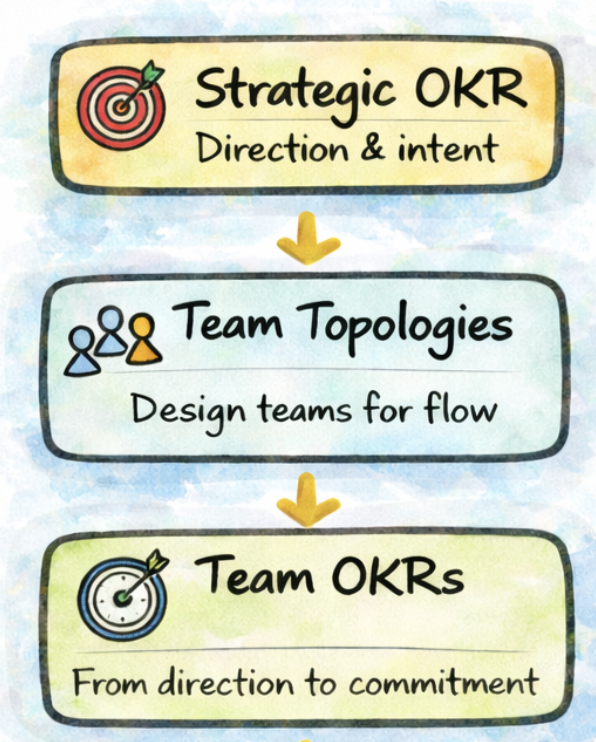
This connection can be understood as a simple chain.
Strategic OKRs provide direction and intent.
Team Topologies help design teams so that value can flow.
Team OKRs translate that direction into commitment at the team level.
Direction → Structure → Commitment
I explore this connection in more detail in
From Direction to Commitment: Connecting Strategic OKRs, Team Topologies, and Team OKRs.
When these layers are connected, teams gain both clarity and autonomy.
They understand where the organization is trying to go — and they take responsibility for achieving meaningful outcomes within their domain.
But even with direction and commitment in place, another challenge remains.
How do teams move from intention to impact?
Discovery and Delivery: The Work of the Team
In practice, teams turn strategy into outcomes through two continuous activities: discovery and delivery.
Discovery focuses on understanding problems, validating assumptions, and exploring possible solutions.
Delivery focuses on building and releasing working products that generate real feedback and measurable results.
These two activities reinforce each other.
Discovery generates insights and hypotheses.
Delivery produces working solutions and real usage data.
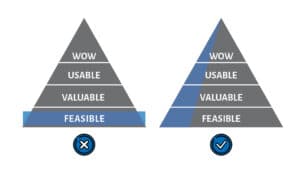
Successful MVPs sit at the intersection of four perspectives: valuable for the business, usable for the user, feasible from a technology standpoint, and compelling enough to create a “wow” experience.
Together they create a continuous learning loop.
A useful way to understand this dynamic is through the relationship between OKRs and MVPs.
I explore this relationship in more depth in OKR vs. MVP: How to Connect Strategy and Execution in Practice.
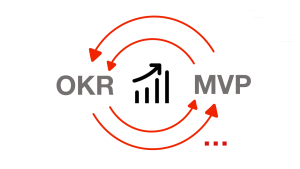
Virtuous OKR–MVP Cycle: each learning reinforces the next step.
An OKR defines the outcome the team wants to achieve.
An MVP (Minimum Viable Product) allows the team to test whether a particular idea can move that outcome.
The MVP is the smallest product capable of generating real learning with users — a concept popularized in the Lean Startup movement. If you’d like to explore the concept further, I explain it in more detail here:
MVP: How to Build the Minimum Viable Product.
Workshops such as Lean Inception help teams align on the first MVP and the hypotheses they want to validate.
I explain the method in more detail in Lean Inception: Learn How to Align People and Build the Right Product.
OKR provides direction.
MVP provides evidence.
Each MVP generates learning that informs the next decision.
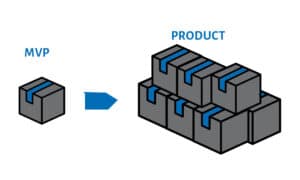
validate → learn → evolve
When teams want to structure these experiments more clearly, tools like the MVP Canvas help articulate the hypothesis, the user segment, the expected results, and the metrics that will validate the idea.
I explain this tool in more detail here: The MVP Canvas.
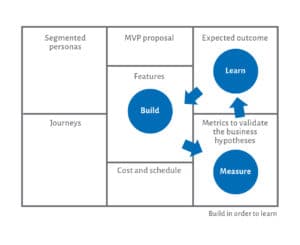
The MVP Canvas helps teams structure experiments and validate product hypotheses.
Over time, this cycle transforms strategic intent into measurable progress.
Three Levels of Execution
To make this system work in practice, organizations must separate three different levels of decision-making.
Each level answers a different question.
Strategic Level — Direction
At this level, leadership defines long-term priorities and strategic intent.
Strategic OKRs often live here.
This level answers the question:
Where are we trying to go?
Outcome Level — Commitment
Teams translate strategic direction into clear outcome commitments for a shorter horizon.
This is where teams define what meaningful progress looks like.
Team OKRs typically operate at this level.
This level answers the question:
What meaningful result are we committing to achieve next?
Execution Level — Work
Teams organize the activities, experiments, and deliveries needed to pursue those outcomes.
Plans, tasks, and technical work live here.
This level answers the question:
What work are we doing to achieve the outcome?
Separating these levels helps organizations avoid a common trap:
confusing activities with outcomes.
Execution supports outcomes.
Outcomes support strategy.
But when these layers collapse into each other, teams lose focus and organizations lose visibility into real progress.
Triple Track, One Team
This interaction between strategy, discovery, and delivery can be understood through what I call Triple Track Development.
I explain the concept in more detail in Triple Track Development: Business Innovation Through Continuous Discovery and Continuous Delivery.
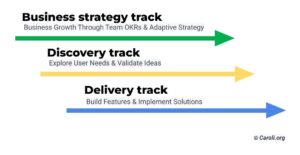
continuous triple track
The three tracks represent three essential dimensions of modern product teams:
Business Strategy
Defining the outcomes the team wants to achieve.
Discovery
Exploring ideas and validating assumptions.
Delivery
Building and releasing solutions that generate real feedback.
These tracks are not separate teams or departments.
They operate within one unified product team.
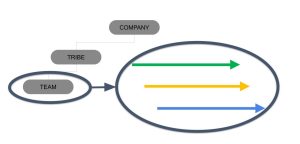
The same team that defines a Team OKR is also responsible for discovering possible solutions and delivering product increments that generate learning.
This is why the concept of Triple Track, One Team is so important.
Strategy provides direction.
Discovery explores possibilities.
Delivery brings ideas into the real world.
Together they create a continuous flow from direction to learning to execution.
From Strategy to Outcomes
When we connect these elements, a clearer system emerges.
Strategy defines the direction.
Teams take ownership of outcomes.
Discovery and delivery become the mechanisms through which teams learn and act.
Over time, outcomes generate new information that influences future strategic decisions.
In simplified terms, the flow looks like this:
Strategy → Teams → Discovery → Delivery → Outcomes
Each element reinforces the others.
Strategy provides purpose.
Teams create commitment.
Discovery reduces uncertainty.
Delivery generates real impact.
Outcomes provide feedback for future strategy.
When this system works well, organizations stop relying on rigid plans and start evolving through continuous learning and delivery.
The Real Shift
Many organizations believe the challenge is choosing the right framework.
Should they adopt OKRs?
Improve discovery?
Reorganize teams?
Accelerate delivery?
In reality, the challenge is not choosing one practice.
It is connecting them into a coherent system.
Strategic OKRs clarify direction.
Team Topologies enable flow.
Team OKRs create commitment.
Discovery and MVPs validate ideas.
Delivery turns ideas into working products.
Together, these elements form the missing link between strategy and outcomes.
Not a rigid process.
But a system in which empowered teams continuously transform strategic direction into measurable results.
And when that system works, something important happens.
Strategy stops being a document.
It becomes something that moves through teams and turns into outcomes.
————–
Note: This article is an evolving placeholder for a model I’ve been developing and using in workshops with teams.
Over time, I will continue refining the ideas, improving the diagrams, and adding links to related practices such as OKRs, Lean Inception, MVPs, and Triple Track Development.
My intention is that this article gradually grows into a more complete guide — possibly even a short ebook.
For now, it serves as a living document that connects the concepts and materials I’ve been using with organizations.