




OKR vs. MVP: Understand the difference — and discover how using OKR and MVP together can turn strategy into validated impact.
OKR vs. MVP: Introduction
“OKR vs. MVP” is a common question among teams and leaders trying to connect strategy, execution, and learning.
This is especially true for product and innovation teams, where these two practices coexist in everyday work.
In this article, I explain how OKR and MVP complement each other — OKR provides strategic direction, while MVP validates the path through real learning.
It’s a recurring topic in my conversations with leaders and teams.
As the author of Lean Inception — a methodology for collaboratively defining the roadmap and the MVP — and Team OKR — focused on aligning teams around outcomes, not tasks — I hear the same question over and over:
“Are OKR and MVP competing approaches, or do they reinforce each other?”
My answer is simple and practical:
OKR is the compass.
MVP is the first validated step on the trail.
Both exist to deal with uncertainty.
-
OKR turns strategy into tangible outcomes.
-
MVP reduces risk and accelerates learning by testing hypotheses with the smallest functional version possible.
When used together, OKR and MVP don’t compete — they strengthen each other.
OKR sets the direction;
MVP provides evidence for the next step.
Together, they keep strategy alive, adaptive, and grounded in reality.
About OKR
Before we explore how OKR and MVP connect, it’s important to understand each one separately.
Let’s start with OKR — the system that helps teams turn purpose into direction, and direction into results.
What is OKR (Objectives and Key Results)?
OKR is the compass that connects purpose to results.
OKR — Objectives and Key Results — is a simple and powerful way to translate strategy into execution.
It links the organization’s larger purpose to the daily work of teams, ensuring everyone moves in the same direction.
In practical terms, OKR turns intention into focus, and focus into impact.
The Objective: Direction and Purpose
The Objective answers the question: “Where do we want to go?”
A good Objective should be:
-
clear,
-
inspiring,
-
connected to the desired future.
It should not describe tasks.
It expresses intention and direction — a shared purpose that unites the team without prescribing the path.
The Key Results: Progress and Evidence
Key Results are the evidence of progress.
They’re measurable changes that show whether we’re truly advancing — not just keeping busy.
A strong KR:
-
measures impact, not effort;
-
tracks movement, not activity;
-
reflects real change in user behavior or business performance.
This is the essence of OKR:
-
The Objective inspires and guides.
-
The Key Results reveal whether we’re actually moving forward.
A Practical Example of OKR
Here’s a simple OKR example:
Objective:
Make the app the leading reference for user engagement in Brazil.
KR1: Increase daily active usage by 20%.
KR2: Raise NPS from 45 to 60.
KR3: Increase the rate of completed onboarding to 70%.
Notice:
Each KR represents a real shift in behavior or outcome, not a task to execute.
The OKR defines the impact we want, and the KRs show how close we are to achieving it.
Why OKR Is Essential
The real value of OKR lies in shifting the team’s focus — from output to outcome, from doing to moving.
It helps teams answer questions that truly matter:
-
“What do we actually want to achieve this cycle?”
-
“How will we know we’re making progress?”
More than a goal-setting model, OKR is a system of alignment and learning.
It provides clarity of direction while leaving room for the team to discover how to create impact.
But this raises a practical question every team faces:
How do we know if the path we chose will truly lead to the results we expect?
And this is exactly where the MVP comes in — the validation mechanism that connects hypothesis to evidence.
About MVP
Now that we understand how OKR gives teams a clear direction toward meaningful results, it’s time to look at the other side of the system: the MVP.
If OKR defines where we want to go, the MVP helps us test whether the path we’re choosing will actually get us there — using real data, not assumptions.
What Is MVP (Minimum Viable Product)?
MVP is the first validated step toward the vision.
The Minimum Viable Product is the smallest functional version of an idea capable of generating validated learning.
Its purpose is not to deliver “less.”
Its purpose is to learn quickly, reducing risk and avoiding waste.
While OKR defines the destination, the MVP shows how to test whether we’re on the right path.
A Practical Example of MVP
Imagine a team with this OKR:
Objective: Increase conversion in the checkout flow.
KR: Improve checkout completion rate by 20%.
Instead of rebuilding the entire payment experience, the team formulates a simple hypothesis:
“We believe that a simpler form will reduce friction and lead to higher conversion rates.”
The MVP is a lighter version of the checkout, with fewer fields and autofill enabled.
It’s released to a small percentage of users over a few days.
What happens?
-
The completion rate jumps by 12% in the test group.
-
The data confirms the hypothesis.
-
The team rolls out the improvement to the full user base.
This is the role of the MVP: test real hypotheses with minimal effort, turning ideas into concrete learning.
The True Purpose of the MVP
The MVP exists to test hypotheses with real users, using data instead of opinions.
It can take many forms:
-
a clickable prototype,
-
a landing page,
-
an A/B test,
-
a manual pilot,
-
a minimal feature released to a small audience.
The MVP format varies — but the principle stays the same: Validate before scaling.
A good MVP answers a practical question:
“What can we deliver right now to test if we’re headed in the right direction?”
The MVP doesn’t chase perfection — it chases evidence.
Its value lies in turning uncertainty into learning — and learning into decision-making.
MVP Goes Beyond Product
Although the “P” stands for Product, and the concept emerged in Silicon Valley, MVP is much broader than software.
An MVP can be:
-
an internal process,
-
a new user journey,
-
a pilot service,
-
or even a business change.
What matters is that it is minimal enough to test and viable enough to generate real usage.
MVP in Lean Inception
Lean Inception is a collaborative workshop that helps teams align vision, objectives, and hypotheses — leading them to a shared, validated definition of the MVP.
It brings business, UX, and technology into one structured conversation, ensuring everyone shares the same understanding before building anything.
In Lean Inception, the MVP canvas is the central outcome: a lean, strategic, and validated plan for the team’s first step toward the product vision.
It’s the moment where strategy and execution meet — transforming intention into real learning.
The MVP is where the big dream meets real data.
See also: Lean Inception: Learn How to Align People and Build the Right Product
OKR vs. MVP: Essential Differences
The confusion between OKR and MVP is natural — after all, both were created to help teams navigate uncertainty.
But they play different — and complementary — roles:
-
OKR defines the focus and the outcomes that matter.
-
MVP tests the path to achieving those outcomes.
OKR is a strategic direction tool that turns intention into clear, measurable results.
MVP is a validation tool that turns hypotheses into real learning.
OKR defines the destination. MVP tests the path.
Together, they create a system of strategy + experimentation that keeps teams aligned and adaptive.
Comparing OKR and MVP
The table below summarizes the key differences between OKR and MVP.
Each plays a distinct role:
-
OKR focuses the team and defines what meaningful progress looks like.
-
MVP validates, with real-world evidence, whether the chosen path can actually generate that progress.

comparative OKR vs. MVP table
OKR vs. MVP: The Key Question
Each tool answers a different question:
-
OKR asks: “Where are we going?”
It clarifies purpose, direction, and strategic focus. -
MVP asks: “What should we test next?”
It guides the next practical step based on learning and evidence.
OKR points to the north.
MVP tests the trail that leads there.
The first guides strategy; the second confirms the path.
OKR vs. MVP: Time Horizon
OKR operates on broader cycles — typically quarterly — long enough to pursue meaningful shifts and observe real change.
MVP moves on shorter rhythms — days or weeks.
Its goal is to test hypotheses quickly and adjust before investing heavily.
Think of it like this:
-
OKR sets the quarterly direction.
-
MVP accelerates weekly learning.
One moves at the pace of strategy.
The other, at the pace of experimentation.
OKR vs. MVP: Unit of Value
OKRs measure value through outcomes — progress in Key Results that reflect real change in behavior or business performance.
This shows whether we’re truly moving in the right direction.
MVPs measure value through validated evidence — real usage data that tells us whether a hypothesis is promising and capable of influencing the desired outcomes.
Both create value, but in different ways:
-
OKR shows impact achieved (via KRs).
-
MVP shows evidence discovered (via experiments).
OKR vs. MVP: Commitment
OKR represents the team’s commitment to the outcomes — to shifting the metrics that truly matter.
It’s a shared responsibility to pursue meaningful impact.
MVP represents the commitment to validation — the smallest functional experiment that allows the team to verify, with real data, whether an idea can actually move the intended KR.
OKR = commitment to impact.
MVP = commitment to evidence.
One guides collective effort; the other ensures the effort is heading in the right direction.
OKR vs. MVP: Expected Output
OKR produces moved KRs — clear indicators of real progress.
MVP produces evidence for decision — insights that help the team determine whether to continue, adjust, or pivot.
OKR reveals impact.
MVP reveals the path.
Together, they turn intention into learning, and learning into results.
OKR + MVP — How They Work Together
OKR and MVP are not isolated methods.
They form an integrated system of continuous learning, where strategy and experimentation reinforce each other.
-
OKR sets the direction — defining the outcomes that truly matter.
-
MVP validates the path — testing the hypotheses that might lead to those outcomes.
While OKR provides the strategic north, MVP turns intention into evidence.
When used together, they create a sustainable rhythm of progress:
the team stops merely planning and starts acting, learning, and adjusting with purpose.
The OKR–MVP Cycle
The flow between OKR and MVP is simple — and powerful.
-
OKR clarifies the desired outcome, translating strategy into measurable results.
-
MVP turns that outcome into a concrete, testable hypothesis that can be validated with real data.
Each MVP is an opportunity to learn whether the team is truly moving in the direction defined by the OKR.
-
If the experiment produces positive signals, the path is reinforced.
-
If not, the learning points to the next logical step.
This cycle closes the loop between strategy and execution, turning every MVP into a validated step toward the KR.
Each iteration sharpens the team’s understanding of what actually creates impact — adjusting focus based on facts, not assumptions.
OKR guides the direction.
MVP confirms the path.
They operate at different rhythms — the pace of strategy and the pace of experimentation —
but they converge on the same purpose: moving what really matters.
Questions That Guide the OKR–MVP Cycle
The connection between strategy and execution becomes stronger when teams ask the right questions.
Two simple questions keep OKR (direction) and MVP (validation) fully aligned:
From OKR to MVP
“What is the minimum thing we can deliver to know whether we’re on track toward the OKR?”
This shifts the team’s focus from “What should we build?” to “What do we need to validate right now to move our KRs?”
It directs energy toward what truly matters:
a small, functional MVP capable of generating meaningful learning.
From MVP to OKR
“What did we learn — and how did that impact (or not impact) our KRs?”
This question ensures that lessons from the MVP flow back into strategy.
The team analyzes the evidence and connects results to KR movement:
-
If the KR moved, the hypothesis gains strength.
-
If it didn’t, learning continues — adjusting the next MVP or exploring a new hypothesis.

OKR–MVP Cycle: the continuous learning between direction and action.
These two questions create a continuous loop between direction and action, connecting purpose and execution in everyday work.
How to Avoid the Cascade and Strengthen Team Autonomy
The OKR–MVP cycle only works when teams have autonomy.
When OKRs are handed down fully defined from the top, teams lose the opportunity to genuinely commit.
Instead of learning, they simply execute.
Instead of testing hypotheses, they complete tasks.
This is the classic trap of “cascaded OKRs.”
Everything looks organized on paper — but the strategy stops being alive.
The Role of Leadership
Leadership’s job is not to prescribe the path.
Leadership defines the direction and the strategic outcomes that matter.
And then?
The team must have the space to discover how to get there.
This is where real ownership emerges.
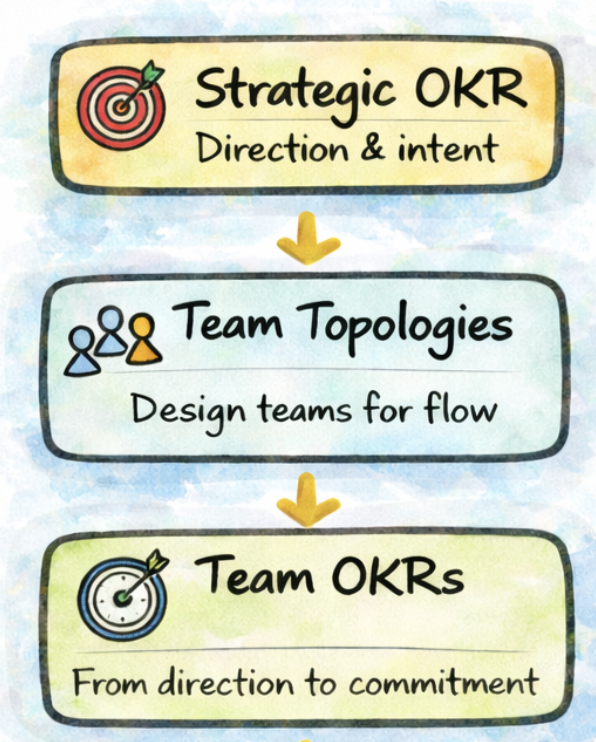
Each team translates the strategic direction into its own Team OKR — with Objectives and Key Results that make sense in its own context.
(I wrote a full book about this because I believe Team OKR is where alignment and autonomy truly meet.)
📘 See the book: Team OKR in Action: How Real Teams Turn Strategy Into Results.
From Strategy to Validation: The Team’s Role
Once the team defines its Team OKR, it decides which hypotheses are worth testing first — and turns each one into a minimal, testable MVP.
-
OKR guides the purpose and the desired outcome.
-
MVP brings the practical validation — real data, real usage, real learning.
During check-ins, the team reviews what it learned and decides the next step:
-
continue,
-
adjust,
-
or pivot.
Leadership points to the north.
The team builds the path.
This is how the OKR–MVP cycle stops being a top-down process and becomes a culture — grounded in clarity, autonomy, and real learning.
OKR, MVP, and the Virtuous Cycle
When OKR and MVP work together, a virtuous cycle emerges.
Each learning reinforces the next step.
Teams move with more clarity, purpose, and confidence.
-
OKR sets the direction — defining the result that truly matters.
-
MVP validates the path — turning intention into practical evidence.

Virtuous OKR–MVP Cycle: each learning reinforces the next step.
Every cycle becomes an opportunity to experiment, measure, and learn.
-
If the MVP moves the KRs, the path is reinforced.
-
If it doesn’t, the hypothesis changes — but the learning continues.
The Secret of the Virtuous Cycle
The key insight is this:
Learning doesn’t end the process — it renews it.
When an MVP doesn’t generate the expected impact,
the team doesn’t change the OKR —
they change the approach.
The Objective remains the same.
The attempt evolves.
Over time, this rhythm becomes natural.
Teams stop merely planning and start evolving through continuous learning — in short, intentional, evidence-based cycles.
Strategy stops being static and becomes alive — adjusting based on facts, not opinions.
This is how OKR and MVP complete each other:
-
OKR defines what matters.
-
MVP shows what works.
Together, they transform intent into learning, and learning into results.
OKR vs. MVP: Real Examples I’ve Seen in Practice
Over the years, I’ve worked with many teams using OKR and MVP together — and the same pattern keeps showing up.
Teams that truly evolve don’t treat OKR and MVP as separate rituals.
They treat them as parts of the same system.
They turn strategy into experimentation — and experimentation into results.
Here are three real examples I’ve witnessed.
Example 1 — Content App
OKR: Increase active user engagement by 20%.
The team started with a simple hypothesis:
launch a feature to recommend personalized articles.
MVP:
A very basic recommendation engine released to a segment of users.
Result:
Retention increased only 3 percentage points — not enough to influence overall engagement.
Instead of changing the Objective, the team changed the hypothesis.
They tested personalized notifications to encourage daily return.
MVP #2:
Simple, targeted reminders based on reading preferences.
Outcome:
Engagement jumped by more than 18%, and the KR was achieved.
Example 2 — E-commerce
OKR: Reduce checkout abandonment by 15%.
Data showed that many users were dropping off at the payment step.
Hypothesis:
The form was too long and created friction.
MVP:
A simplified version of the checkout with fewer fields and autofill.
Outcome:
Immediate drop in abandonment and higher completion rates.
With the hypothesis validated, the team rolled out the improvement to all users — confirming that simplifying the process moved the KR.
Example 3 — EdTech
OKR: Increase course completion rate by 25%.
The problem was clear: students started courses but rarely finished.
Hypothesis:
They lacked motivation and a sense of progress.
MVP:
Simple reminders and shorter, structured study paths.
Outcome:
Students who received reminders completed up to 22% more lessons.
The team scaled the initiative, validating that small incentives can generate big results.
The OKR–MVP Cycle in Action
Across all these cases, the pattern is the same:
-
OKR defines the outcome that matters.
-
MVP validates the path with real evidence.
-
Learning guides the next step.
This is the true OKR–MVP cycle in action:
Less planning, more learning.
Less assumption, more results.
OKR and MVP: 7 Anti-Patterns (and How to Avoid Them)
Not every use of OKR and MVP leads to learning.
Many teams start well — and then fall into common traps that distort the purpose of both practices.
Over the years, I’ve seen the same patterns repeat across all kinds of teams.
Below are the 7 most common anti-patterns I’ve observed — and, more importantly, how to avoid them.
1. Cascading OKRs from the Top Down
When OKRs come fully defined from leadership, the team doesn’t commit — it complies.
They execute what was handed to them without understanding the “why.”
Learning dies before it even starts.
This is the classic top-down OKR cascade:
everything looks organized, but no one is truly committed.
How to avoid it:
-
Leadership defines direction and strategic outcomes.
-
Teams define their own Team OKRs, then choose the MVPs that will test hypotheses in that direction.
When teams define their own OKRs and hypotheses,
they commit to the outcome, not to a task list.
2. Starting OKRs from the Backlog (Instead of Generating the Backlog)
Some teams begin the cycle by looking at their existing backlog.
They try to fit old tasks into new OKRs.
The result?
An OKR that’s just a “label” for what was already decided.
How to avoid it:
Start with the desired outcome (OKR).
Then derive the MVPs that can validate hypotheses capable of moving that outcome.
The sequence should be:
KR → MVP → Backlog
not
Backlog → OKR.
This is how teams connect what they do to the impact they seek.
3. Confusing KPIs with KRs (Measuring Without Learning)
KPIs tell you the system’s health.
KRs push the system forward.
Many teams confuse the two — and end up measuring without learning.
They monitor dashboards, analyze trends, and produce beautiful reports…
but nothing changes.
They fall into the trap of analysis without action.
Not every metric needs to become an OKR.
-
KPIs show what needs to stay healthy.
-
OKRs show what needs to change.
Turn everything into OKR, and the team loses focus and motivation.
How to avoid it:
-
Choose one KPI that must move now,
and transform it into a KR. -
Create an MVP to provoke that movement.
Measuring is not enough.
Learning and deciding is what makes teams evolve.
4. Turning KRs into Outputs (and MVPs into Deliverables)
“Release new version,”
“Integrate API,”
“Add chat” — none of these are outcomes.
They are outputs, not KRs.
Without clarity, teams call any feature an “MVP” and any task a “KR.”
They stay busy, but don’t advance.
How to avoid it:
Write KRs as desired effects, not actions.
Define MVPs as experiments that test whether that effect happens.
Example
Instead of “Add chat”:
-
KR: Reduce average response time from 10 → 3 minutes.
-
MVP: Launch a simple chat feature to validate whether direct interaction reduces response time.
5. OKRs Without measurable KRs (or with KRs That Don’t Move)
Sometimes a team creates a great Objective — inspiring, strategic — but the KRs are vague (“improve,” “increase,” “reduce”) or, worse, nonexistent.
Without clear, measurable KRs, the OKR becomes a motivational poster.
And without KRs, you can’t know whether an MVP had impact.
How to avoid it:
Write specific, measurable KRs with clear boundaries.
Prefer relative changes (“+20%”, “−10 p.p.”) or explicit targets.
If you can’t measure the movement, it’s a sign the KR still isn’t well-defined — and the MVP will lose focus.
6. MVPs That Are Too Big (Mini-Projects in Disguise)
Another common mistake: calling something an “MVP” when it takes months, requires multiple teams, and only generates learning at the end.
When an MVP is too big, it loses the essence of quick, validated learning.
The team slips back into the old pattern of
“deliver first, learn later.”
How to avoid it:
Return to the essence: the M in MVP matters most.
An MVP should produce learning in days or a few weeks.
If the team needs a roadmap, approvals, and detailed requirements before starting…
it’s no longer an MVP.
7. Learning Without Deciding
This is one of the most subtle — and dangerous — anti-patterns.
Many teams experiment, measure, and analyze…
but stop there.
Learning doesn’t turn into decision.
Data becomes dashboards.
Graphs are presented in meetings.
And the next cycle starts as if nothing happened.
The team learns — but doesn’t change.
Learning without decision is just information accumulation.
How to avoid it:
Never stop at learning —
close the loop and feed the next step.
Every MVP must lead to a clear choice:
-
continue,
-
adjust,
-
or pivot.
Without decision, learning dies.
How High-Performing Teams Behave
After observing these anti-patterns across many organizations, I noticed a common trait among the teams that actually get it right:
They don’t treat OKR as a plan — they treat it as a declaration of intent.
These teams understand that OKR doesn’t describe the path.
OKR describes the destination.
They don’t pretend to know every step in advance —
and that’s exactly the point.
The OKR points to the desired future;
the path is discovered one experiment at a time.
Their sequence looks like this:
-
They align on the OKR that matters — the outcome truly worth pursuing now.
-
They choose the MVP that tests the path — the smallest hypothesis capable of generating real evidence.
-
They measure what genuinely changes — connecting learning to decision-making.
This simple, disciplined, iterative cycle transforms OKR–MVP from a bureaucratic exercise into a living learning system.
A system where:
-
every delivery becomes learning
-
and every learning becomes progress.
It’s how teams turn strategy into experimentation, and experimentation into results, without losing autonomy, purpose, or clarity.
How to Connect OKR, MVP, and the Backlog
For the OKR–MVP cycle to truly work, it must be connected to both strategy and day-to-day execution.
Without this connection, a team may run fast — but often in the wrong direction.
Think of the system as a set of nested layers, each feeding the next:

Vision → Strategy → Team OKR → MVP → Backlog
A chain that moves from purpose to action, and from action back to learning.
Vision → Strategy
The vision is the long-term north star — the future that inspires and guides.
Strategy translates that vision into choices:
where to focus, what to prioritize, what matters now.
When this layer is clear, OKRs make sense.
When it’s fuzzy, teams drift into generic or disconnected objectives.
Strategy → OKR
Leadership sets the direction and the strategic outcomes — often expressed as organizational OKRs.
Each team then translates that direction into its own Team OKR, adapted to its reality, context, and capabilities.
This is the moment when strategic intent becomes a measurable commitment.
OKR → MVP
Once the OKR is set, a practical question emerges:
“What is the smallest experiment that can tell us whether we’re moving in the right direction?”
That’s the role of the MVP — the first, leanest bet that connects strategic outcomes to real-world learning.
This is where Lean Inception helps: business, UX, and tech make the decision together about which hypothesis to test first.
MVP → Backlog
The backlog is born from the MVP — not the other way around.
And not as a task list, but as a sequence of hypotheses, experiments, and learning-oriented deliveries.
Every backlog item exists for one purpose:
to help the team learn something critical about whether they’re on the right path to the OKR.
With each cycle, evidence from the MVP validates (or adjusts) what stays, what changes, and what gets removed.
The backlog becomes dynamic — shaped by evidence, not by assumptions.
From Purpose to Action: The Full Flow
The OKR–MVP cycle doesn’t live in isolation.
It’s part of a larger flow that connects purpose, strategy, and execution into one coherent movement.
When the full flow is working, each layer feeds the next — and learning feeds back into strategy:
Vision → Strategy → OKR → MVP → Backlog → Learning → New Strategy
-
Vision inspires — the desired future, the “why.”
-
Strategy provides direction — the choices and priorities.
-
OKR defines what must change now to move toward that vision.
-
MVP tests the path — hypotheses with the smallest viable effort.
-
Backlog turns validation into actionable work.
-
Learning closes the loop — evidence refines the next strategy.
When this flow runs smoothly:
-
teams stop just executing plans
-
and start evolving with intention
-
delivering with purpose
-
guided by evidence, not opinion.
Strategy gains rhythm.
Execution gains meaning.
And the organization evolves with clarity and coherence.
Conclusion — OKR and MVP: From Tools to a Learning Culture
OKR and MVP were both created to help teams navigate uncertainty.
But their true power emerges when they stop being tools — and start becoming part of the culture.
When a team understands that:
-
OKR is direction, not a plan, and
-
MVP is a hypothesis, not a deliverable,
everything changes.
The conversation shifts from “What should we build?” to:
“What do we need to learn to achieve the result?”
This is the essence of the OKR–MVP cycle:
-
define what matters,
-
test with intention,
-
evolve through evidence.
It’s the transition from a culture of control to a culture of learning.
-
Every OKR gives meaning.
-
Every MVP brings clarity.
-
Every learning strengthens the next step.
In the end, success doesn’t come from planning everything perfectly.
It comes from learning enough to move forward, cycle after cycle, with purpose and evidence.
If you enjoyed this article and want to go deeper
There are several paths you can explore:
📘 Prefer reading?
Check out my books Lean Inception and Team OKR.
💼 Work in a company and want to bring this cycle to your team?
Take a look at the services I offer — or even better, send me a message on LinkedIn or through Caroli.org and we can schedule a conversation.