Today, a good friend of mine asked me “for that sentence you usually read at the beginning of a retrospective”. He was talking about the retrospective prime directive: Regardless of what we discover, we understand and truly believe that everyone did the best job they...
Author
Paulo Caroli

More from Paulo Caroli
Blog Posts
GOSH event photos
GOSH – Get Old Stay Hot Last night I had the honor of facilitating the first GOSH (Get Old Stay Hot) event. The event was opened for the Porto Alegre local IT community. It had the focus on career development (therefore the catchy acronym). It took place at...
Facilitation activity: feedback and ROI
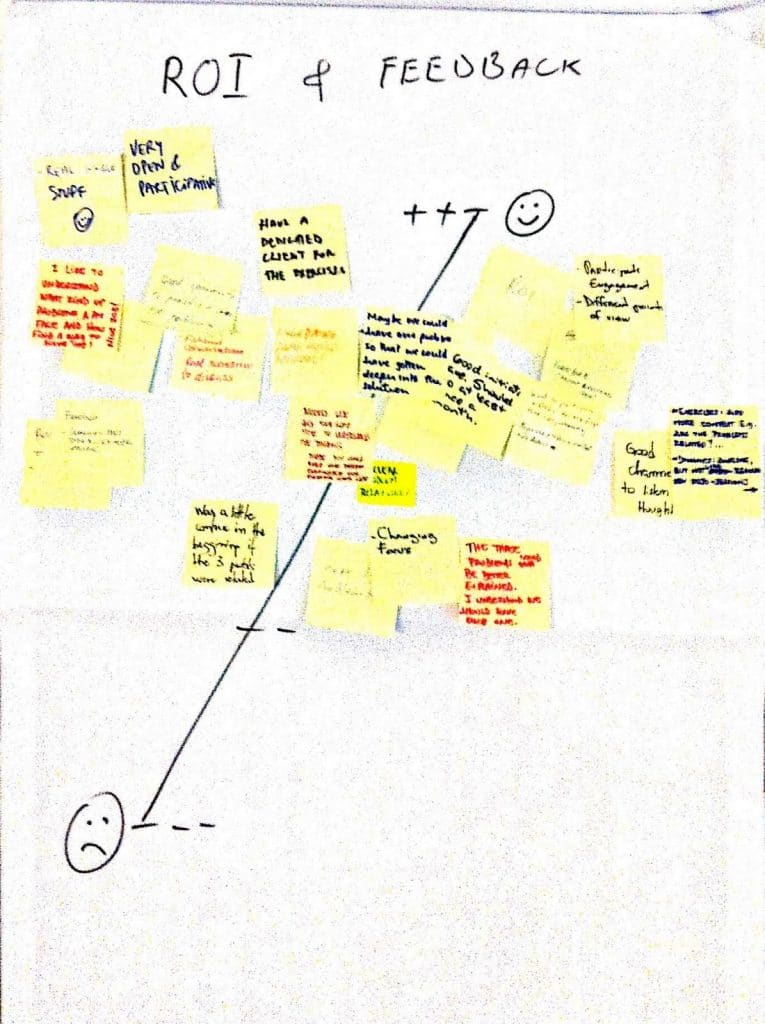
Facilitation exercise: feedback and ROI (Return on Investment) I have been using this facilitation exercise for a while. Therefore I am describing it in this blog entry. This is a great exercise for closing a retrospective, a long meeting, or an event). Basically I...
facilitation exercise: The round table fishbowl for group discussion
I have used this facilitation exercise in a few instances. Therefore I will describe it in this blog entry. This exercise is great for keeping a focused conversation, while having a large group of people. At any time, only a few people have a conversation (the fish in...
The world is flat
Here is my friend and coworker Ygor in front a flat screen tv connecting Porto Alegre to San Francisco, Ohio and Bangalore. For Ygor the world is flat. Flat as that 32 inches tv which he uses to communicate with a distributed agile team with a common goal of building...
Little Law, lead time, cycle time and throughput
In this blog post, the concepts of Little’s Law, lead time, cycle time, and throughput are explored through an analogy involving whisky bottles. Two problem statements concerning whisky consumption and purchases are presented, leading to the derivation of key parameters such as work in progress (WIP), throughput, cycle time, and lead time. The post offers two solutions that highlight the equivalence of the formulas employed, simplifying intricate concepts in queuing theory for readers. Additionally, the Cumulative Flow Diagram is introduced as an efficient tool for visualizing and managing work processes.